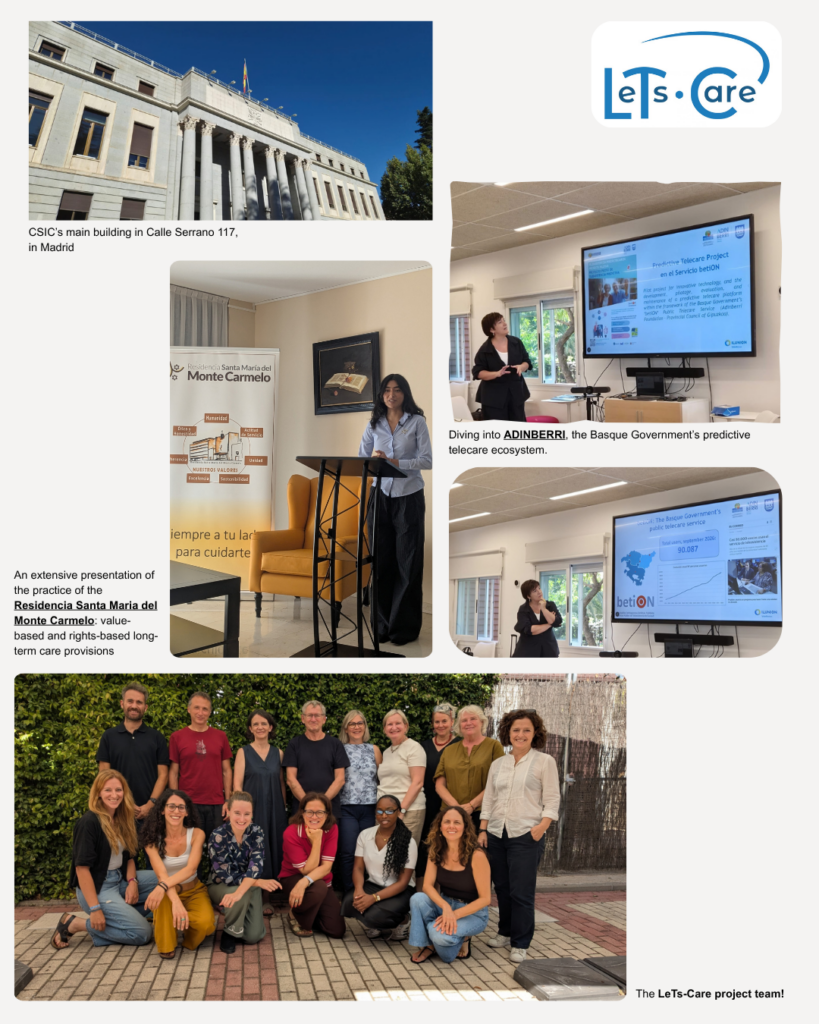
The LeTs‑Care partners gathered last week in Madrid to advance coordination – a moment to align ongoing work and refine next steps – and to add another piece to the puzzle of long‑term care practices across the EU.
With the expert guide of Roberta Perna at IPP-CSIC, the project consortium engaged directly with two visits and observations of two practices, as concrete examples of how person‑centred long‑term care is being shaped and implemented in Spain, offering valuable insights for our collective European learning process.
🔹 Residencia Santa María del Monte Carmelo in Madrid. The partners visited this traditional residential facility, privately owned and managed by the Carmelite fathers, which has been accompanying older adults for decades. The experience was both informative and emotional:
- the value‑based mission serve and protect is visible in everyday interactions
- care is organised around person‑centred and rights‑based principles, ensuring dignity, autonomy, and respect
- the facility operates as an ecosystem of services, responding to different levels of need
- families, when present, are not only involved in the care process but also actively engaged in governance, reinforcing trust and shared responsibility
A key challenge also emerged: 𝘁𝗵𝗲 𝗲𝗰𝗼𝗻𝗼𝗺𝗶𝗰 𝗮𝗻𝗱 𝗳𝗶𝗻𝗮𝗻𝗰𝗶𝗮𝗹 𝘀𝘂𝘀𝘁𝗮𝗶𝗻𝗮𝗯𝗶𝗹𝗶𝘁𝘆 𝗼𝗳 𝘁𝗵𝗲 𝗽𝗿𝗼𝘃𝗶𝘀𝗶𝗼𝗻𝘀, in a regime where most of the fee is borne directly by older residents. This raises important questions about affordability, equity, and the long‑term viability of value‑driven residential care models. These issues resonate across many EU countries.
🔹 The Predictive telecare in the Basque Country. The second observation focused on innovation and policy development. The partners explored the advanced telecare pilot Adinberri, initiated by the Gobierno Vasco (Departamento de Gobernanza Pública y Autogobierno, Dirección de Apoyos para la Vida Plena). Building on the public betiON telecare service, this pilot is supported by ILUNION VidaSenior and the Ibermatica/Ayesa joint venture, and demonstrates how predictive telecare can move from experimentation to structured policy. It shows:
- how technology can anticipate needs and support daily living
- how telecare can reinforce long‑term care systems
- how older people and their families benefit from safer, more connected, and more responsive services
A remarkable example of how digital innovation can complement traditional care models and contribute to more resilient long‑term care policies.
These direct observations enrich the LeTs‑Care consortium’s understanding of what long‑term care looks like in practice, from value‑driven residential care to data‑informed telecare. They also reaffirm the importance of cooperation in shaping inclusive, person‑centred and future‑ready long‑term care systems.